


A woman in her sixties came to me on tirzepatide. The first months had gone well, and then her weight stopped moving. By the usual measure, the drug was still working: her appetite had all but disappeared. She was surviving on bone broth and a single meal a day, while diarrhea had quietly become part of her daily routine. The drug had done its job on her appetite, and the rest of her body was paying for it.
We, humans, will put up with a lot to be thinner, and I see versions of her story all the time. The first few months on a GLP-1 can feel like a miracle. Then the scale stops moving, and the plan on offer is a higher dose or a different brand.
Sometimes that is the right call. More often, the drug is doing exactly what it was built to do and the problem sits somewhere it can’t reach. A GLP-1 turns down appetite. It does not build muscle, repair your sleep, treat your thyroid or feed your gut. Those are the places I look first.

1. You’re losing muscle along with the fat.
Lean tissue makes up roughly a quarter to a third of the weight lost on semaglutide and tirzepatide. Some researchers compare it to a decade of age-related muscle loss. Muscle is the main place insulin sends sugar, and it adds to the energy you burn at rest. Lose enough of it and the next pound gets harder.
If you take one thing from this piece, make it this: sustained weight loss is about building muscle. Strength training has the best data of anything here. Weight loss programs that add resistance training cut the share of weight lost as lean tissue by about a third. Two or three sessions a week is enough. Squats, lunges, rows, presses and deadlifts, heavy enough that the last few reps feel hard, adding weight as you get stronger. A trainer for the first month is money well spent.
2. You’re eating too little, especially protein.
The appetite suppression works so well that many patients drift far below what their body needs. In one small study of GLP-1 users, fewer than half reached even the low end of the protein intake recommended during weight loss. It is exactly what happened to the woman I opened with.
Chronic under-eating is the fastest route to losing muscle, and it leaves people tired, cold, shedding hair and stalled. I aim for about 1.2 to 1.6 grams of protein per kilogram of a reasonable goal weight. For many women that works out to roughly 25 to 30 grams at each meal. Start each meal with a few bites of something bitter, like arugula, dandelion greens, radicchio, endive or some apple cider vinegar in water. Bitter flavors wake up digestion, what traditional medicine calls digestive fire, and lab studies show the gut has its own bitter taste receptors that can trigger GLP-1 release. After bitters or ACV then move to protein before appetite fades: eggs, fish, chicken, Greek yogurt, cottage cheese, tofu, beans and lentils. Real food comes first. Protein powder is a different thing from a meal and should be a small part of your intake, if you use it at all. On the days appetite won't cooperate, a clean one can cover a gap, and I keep the few I trust in my Fullscript shop.
3. Your gut is starving and your elimination is backed up.
Fiber disappears along with everything else when appetite drops, and GLP-1s slow how quickly food moves through the intestine. GI side effects are common on these drugs, and constipation hits about one in four people. Nausea and smaller meals cut fluid intake too. A backed-up gut stalls the scale and makes people feel worse.
Fat tissue also stores environmental chemicals like PCBs and old pesticides, and as fat breaks down they move into the blood. In studies of dieting and weight loss surgery, blood levels of these chemicals rose about 2 to 4% for every kilogram lost and were still elevated a year later, and in one small study that rise tracked with lower active thyroid hormone and a slower metabolism. The liver packages those chemicals into bile and the gut carries them out, so constipation gives them more time to be reabsorbed. I believe keeping that exit route open is especially important during rapid weight loss, though this has not been studied specifically in people taking GLP-1 medications..
Fiber is the tool. Eating vegetables and protein before starches softens the blood sugar rise after a meal, and in a small study raised GLP-1. Gut bacteria ferment fiber into short-chain fatty acids that stimulate your own GLP-1 release. You don’t need to cut carbs; choose the ones that come with fiber. Oats, berries, beans, lentils, quinoa, chia, ground flax and plenty of vegetables, paired with protein and healthy fats like avocado, nuts and olive oil. Build slowly toward 25 to 30 grams a day and drink water with it. Partially hydrolyzed guar gum is gentle when nausea is a factor.
4. You’re moving less than you think.
Less food means less energy, and people quietly stop pacing, fidgeting and taking the stairs. A 2026 review found activity tended to run lower on GLP-1s, though most studies could not show a clear difference. In one analysis of people with type 2 diabetes on liraglutide, it came to about 1,100 fewer steps a day.
The fix pairs with everything else here. Start with the golden rule of blood glucose regulation: walk for at least 10–15 minutes after meals. Moving while blood sugar is rising helps blunt the post-meal spike, and studies show that walking after eating can reduce the rise in blood glucose.
5. Your insulin resistance lives in your muscle.
People with type 2 diabetes lose meaningfully less weight on semaglutide than people without it. Skeletal muscle clears the large majority of the sugar insulin moves out of your blood, and muscle insulin resistance shows up years before diabetes does. A GLP-1 improves insulin sensitivity mainly through weight loss. Exercise works directly on the muscle: a working muscle pulls sugar in without needing insulin, and a single session raises insulin sensitivity for up to 48 hours. So the more insulin resistant you are, the more strength training matters.
6. Your stress is high, and your recovery is low
In a classic metabolic ward study, people on the same reduced-calorie diet lost about half as much fat when their sleep was cut short, and lost more lean tissue instead. A later trial found that losing just one hour of sleep five nights a week shifted weight loss away from fat, even with weekend catch-up sleep. These studies used diet rather than a GLP-1, but the takeaway is very applicable here because short sleep raises hunger, cravings and insulin resistance.
Stress travels with poor sleep. Chronic stress is tied to belly fat, cravings and stress eating. If you snore or wake up unrefreshed, ask to be screened for sleep apnea.
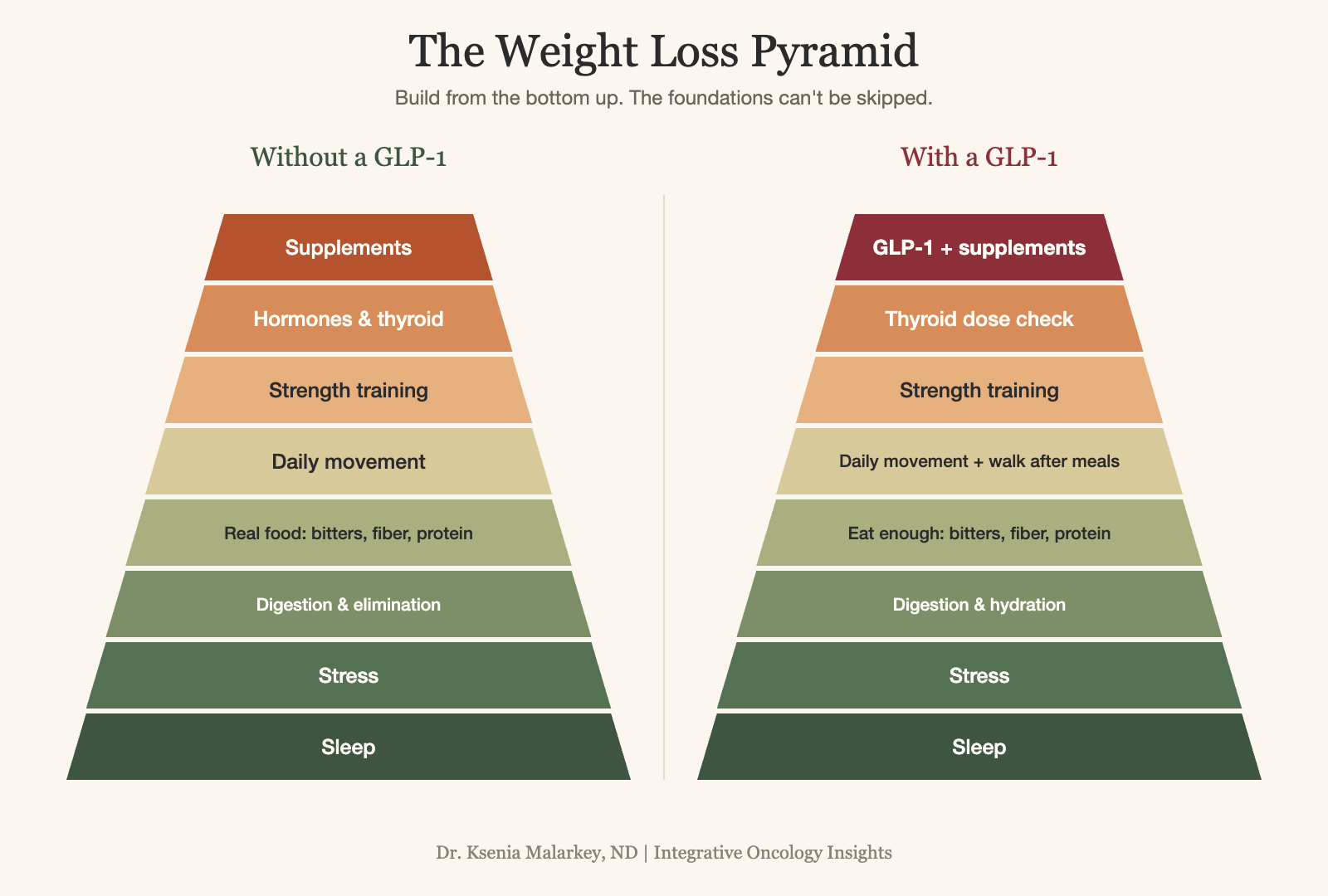
I think of weight loss as a pyramid, and the base can't be skipped. Sleep and stress sit at the bottom, then digestion, real food and daily movement, then strength training and hormones, with supplements at the very top. On a GLP-1, the drug takes that top spot and a few layers shift: hydration joins digestion, eating enough becomes the goal, and strength training stops being optional. A medication at the peak works best on a solid base.
7. Your hormones changed the terrain.
A woman in perimenopause with night sweats, broken sleep and a stalled scale often has one problem with three faces. Falling estrogen breaks up sleep, shifts fat toward the belly and may blunt how well the drug works.
The data points that way. Women usually lose more weight on GLP-1s than men, but that edge shrinks with age and tracks with menopause. In an analysis of two large semaglutide trials presented this year, women over 55 taking estradiol lost more than similar women who weren’t, and most real-world studies of women on hormone therapy show the same pattern. The tirzepatide trials showed less of a gap across menopause stages, so the effect may depend on the drug.
When hormone therapy is already indicated for her symptoms, better sleep and a better GLP-1 response may come along with it. Hormones are a treatment for symptoms rather than a weight loss tool, and a European menopause society has said the same.
8. Your thyroid dose hasn’t kept up with your weight loss
Thyroid is the foundational piece most GLP-1 conversations skip. In a real-world study presented this year, people with hypothyroidism lost about half as much weight on semaglutide as people without it. Yet in another study, people whose hypothyroidism was well treated lost just as much as everyone else on liraglutide. My read is that a well-treated thyroid doesn't hold the drug back, and an under-treated one can.
GLP-1s can also shift your thyroid dose. Slower stomach emptying can change how thyroid medication is absorbed, and as weight comes off, the dose you needed at your heaviest may no longer fit. Case reports describe it going both ways. If you take thyroid medication, have a full thyroid panel rechecked a few months after starting a GLP-1, and again after a large loss.
9. Your GLP-1 might not be what the label says.
In September the FDA reported more than 1,700 adverse event reports tied to compounded semaglutide and tirzepatide and cited dosing errors, contamination risk, warm deliveries and fraudulent product. Eli Lilly has also reported an impurity in compounded tirzepatide mixed with vitamin B12, though the compounding industry says Lilly hasn’t shared enough to evaluate the claim, and Lilly has an obvious financial stake. Blah blah blah. If your response changed after a new batch, a pharmacy switch or a summer shipment, the vial is the first suspect. Ask your pharmacy for third-party potency and sterility testing on your lot.
10. Your body found a new set point.
Every weight loss method ends in a plateau. And, weight loss isn’t linear. In the big trials, most people’s weight curve flattens within the first year to year and a half. GLP-1s weaken the feedback loop that pushes hunger back up as you lose weight, which is why they carry people further than dieting does, but the body still settles at a new set point. A long trial published this year found people on semaglutide no longer felt strong appetite suppression after several months, yet still ate less than people on placebo. If the food noise is back but your weight is holding, the drug is still working, just not in the way you expected.
What to try this month
Start with the first four. They do the most, and they work alongside the drug.
Protect seven to eight hours of sleep, bring stress down daily, and get screened for apnea if you snore.
Lift two or three times a week, focusing on legs, back and hips.
Start meals with a few bites of bitter greens, then protein, about 25 to 30 grams, with starches last.
Raise fiber slowly toward 25 to 30 grams a day, with water.
Walk ten to fifteen minutes after meals.
If you take thyroid medication, have it rechecked.
If you’re in perimenopause with symptoms, have the hormone conversation for its own sake.
If you use a compounded product, ask for lot testing or consider a brand-name version.
The drug handles appetite. Muscle, sleep, hormones, thyroid and your gut are still yours to work on, and in my experience they decide whether the weight stays off.
Ksenia Malarkey, ND is a naturopathic physician specializing in integrative oncology, hormones, and metabolic health.
She provides medical care for Washington and Oregon residents and offers global health coaching.
To schedule a free 15-minute consult, visit drkseniamalarkey.com